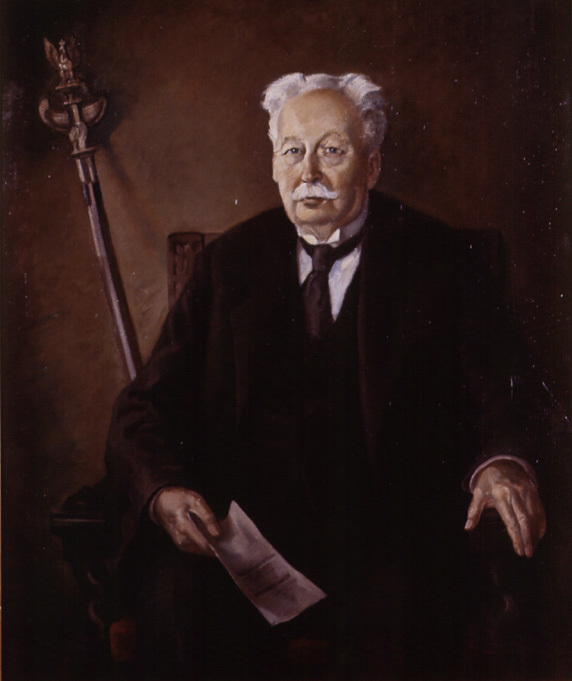
Born on 8 February 1860 in Dębłowo near Gniezno, died on 2 March 1953 in Poznań. He came from landed gentry. Attended secondary school in Trzemeszno and the well-known Maria Magdalena school in Poznań where he passed his matriculation exams in 1877. He studied law in Berlin and Wrocław - he passed his state exams there as well - and settled in Poznań holding his law firm (1886 - 1892) and notary's office from 1892. At that time he was deeply involved in fights for Polish schools, personally arranging private teaching of Polish in Poznań 1890 - 1894. Sitting in the Poznań city council 1901 - 1911, he was chairman of the Polish circle and strongly opposed economic discrimination against Poles. The author of a well-known leaflet published in Polish and German entitled 'Prawo pozostanie zawsze prawem' (Law will always be law), where he criticised the act expropriating Poles as being contradictory to German constitutional laws 1907. A deputy to the Prussian sejm 1910 - 1918 and the German Reich parliament 1912 - 1918, where, due to his excellent knowledge of German language and law, he acquired renown for his matter-of-fact criticism of the government's anti-Polish policy. During World War I, he was a member of the secret Inter- party Civic Committee 1916, and then Central Civic Committee and the Chief People's Council 1918 - 1919, on whose behalf he was nominated chief president of Poznań Province and Regency on 4 January 1919 until its union with Poland. By the terms of Józef Piłsudski's decree, he sat in the Legislative Sejm as a deputy from the Prussian partition lands. He had his mandate confirmed in the by-election of 1 June 1919 in Poznań province in the No 1 constituency from a joint list of the United National Parties. Elected marshal of the Legislative Sejm on 14 February 1919, he was not an official member of any political party from that time. During the Polish-Soviet war, owing to his office, he became a member of the State Defence Council in 1920 and also headed the Central Plebiscite Committee and the Committee for the Aid to Repatriates. In the November 1922 election, he was elected to the RP Senate of I term 1922 - 1927 from the state list on behalf of the Christian Association of National Unity, and on 1 December 1922 he took the office of senate marshal. After Józef Piłsudski's coup d'état, as senate marshal, he had a soothing effect on political atmosphere in Great Poland in 1926. Elected sejm deputy again from the Peasant-National Union Bydgoszcz region in 1928, became vice-chairman of the sejm National Club and a member of the State Debt Control Committee. In the autumn 1930 election, he was put in on ten lists (regional and state ones) of the National Party (SN), where he was a member of the Political Committee, and finally accepted a seat from the Szamotuły district. In sejm he was again in the presidium of the National Club (member) and the State Debt Control Committee. He was known as a fault-finder of sanacja (moral rehabilitation) policy, among others for his question about general Zagórski as well as courageous testimony in the 'Brześć' trial. In parliament, he reacted negatively to the projects of constitutional and electoral law changes. As a SN activist, he was in the Legal Department of the party, and from 1929 was appointed by Roman Dmowski to the Great Council of Great Poland Camp, although he had no important role there. After 1935, he gradually retired from political life and got closer to the opposition centred at the Morges Front. He survived World War II in Warsaw, where he had been displaced by the Germans in 1939, maintained contact with Cyryl Ratajski, the Home Delegate of the Government-in-Exile, collaborated with the Chief Protective Council. After the defeat of the Warsaw uprising, he settled in Milanówek, and in spring 1945 he returned to Poznań. Awarded the Order of the White Eagle and the papal Pius IX Order.