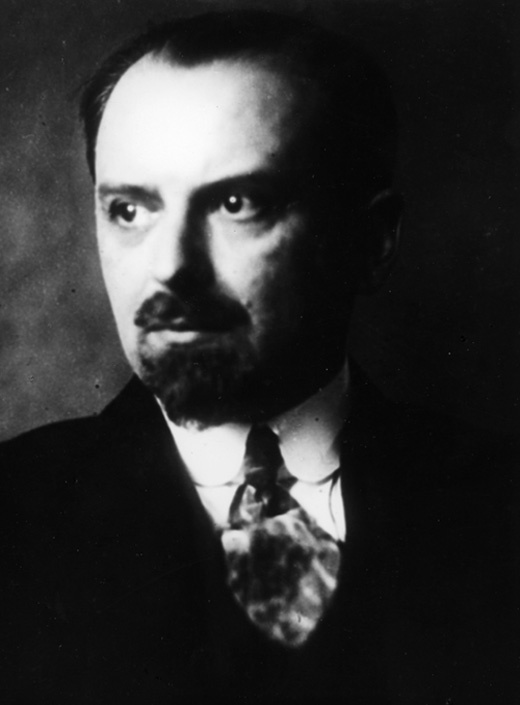
MAKOWSKI WACŁAW (1880 - 1942)
Marshal of the RP Sejm of V term (28 November 1938 - 2 September 1939)
Born on 15 November 1880 in Vilnius in an intelligentsia family. He graduated from
secondary school there in 1898, studied law at the University of Warsaw till 1902, with
complementary studies in Cracow at the Faculty of Philosophy of the Jagiellonian University,
in Lvov and Paris. During studies, he was a member of a revolutionary pro-independence
group, arrested twice by the Russian authorities in 1901 and 1906. He started to work as a
barrister's help and then participated in creating and the activities of the Political Defenders'
Circle 1905 - 1907. During the First World War, after the retreat of Russian authorities from
the Congress Kingdom of Poland, he organised civic jurisdiction, active in the Civic Militia in
Warsaw and the High Protective Council 1915. Connected with the activists' political circles,
he became deputy director of the Justice Department of the newly created Provisional Council
State (January 1917), and between 27 February - 4 April 1918 he was head clerk of the
Ministry of Justice. Appointed by the Polish Regency Council vice-president of the Main
Land Commission on 30 October 1918, he held the post after gaining independence and then
appointed head of a section in the Ministry of Agriculture and State Demesne on 7 February
1919. He also conducted research and teaching work at Warsaw University, lectured on
criminal law at the Law Faculty from 1917, nominated associate professor 1921 and full
professor in criminal law 1923. He worked in the Codification Committee from 1919, was
deputy chairman of the criminal law section 1920. A volunteer for the Polish Army in the
Polish-Russian war of 1920 as prosecutor of the Supreme Military Court. Put on the reserve
list, he was made colonel of the Judiciary Corps of reserve 1922. Minister of justice in the
cabinet of Artur Śliwiński (28 June 1922 - 7 July 1922) and Julian Nowak (31 July 1922 - 14
December 1922) while in the cabinet of General Władysław Sikorski (16 December 1922 - 26
May 1923), he was chief clerk of that ministry. In the three consecutive cabinets of Kazimierz
Bartel (15 May 1926 - 30 September 1926), he was also minister of justice. Played an
important role in designing a bill of the constitution change (called the 'August amendment' 2
August 1926). Elected Sejm deputy from the list of the Non-Party Bloc for Cooperation with
the Government (BBWR) in the Polesie constituency in March 1928. The leader of the
BBWR club, he was deeply involved in jobs on the project of the constitution prepared by the
ruling camp, and became chairman of the Sejm Constitutional Committee. In the November
1930 elections, he held a top position on the BBWR list in Warsaw, chaired the Constitutional
Committee again, was a member of the Legislative Committee and was elected Sejm deputy
marshal (1 October 1931) after Jan Piłsudski's resignation from the office. In the next
elections, he was a candidate for the Senate from Warsaw, became its deputy marshal on 5
October 1935 and, simultaneously, chairman of a legal committee and a member of the Inter-
Parliamentary Union and the leader of the Polish group. He was a member of the Union
Council. At the same time, he lectured on criminal and civil law at Warsaw University, was
dean of the Law Faculty 1935 - 1937, nominated full professor in civil law 1937. On behalf
of the National Unity Camp in Warsaw, elected deputy to the sejm of V term, and, at the first
sitting on 28 November 1938, sejm marshal. He chaired the last debate of the Sejm of the II
Republic of Poland on 2 September 1939, and after the evacuation of the RP authorities to
Romania, he was interned there. Died in Bucharest on 28 December 1942. The author of
many scientific papers on criminal and civil law, co-author of the Criminal Code 1932 and the
April Constitution 1935. Awarded the Polonia Restituta Order Second Class.
Photography of Wacław Makowski
- Mechanical Documentation Archives